Kayaking - Coiba National Park
Kayaking in Coiba National Park
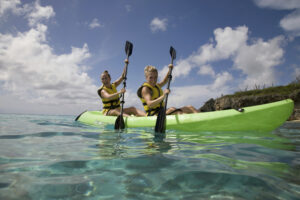
Kayaking offers one of the quietest and most intimate ways to explore Coiba National Park. From the seat of a sea kayak, visitors can paddle beneath forested shorelines, investigate protected coves, glide past mangroves and experience beaches and rocky coasts from an entirely different perspective.
Without the constant sound of a motor, the pace changes. Birds can be heard calling from the forest, fish move beneath the kayak and wildlife along the shoreline can sometimes be observed with considerably less disturbance.
In a national park where the natural environment is the main attraction, that simplicity is exactly what makes kayaking special.
Exploring Coiba from the Water
Most visitors first experience Coiba from a motorboat traveling across the Pacific from the mainland.
A kayak provides an entirely different view.
Sitting only a short distance above the surface places paddlers at the boundary between Coiba’s terrestrial and marine environments. Tropical forest rises directly from the coastline while clear water reveals glimpses of the marine world below.
Instead of traveling quickly from one attraction to another, kayaking encourages visitors to slow down and explore the spaces in between.
Kayaking Through the Mangroves
Some of Coiba’s most fascinating coastal environments are its mangrove forests.
Mangroves grow where land and sea meet, creating sheltered waterways and complex networks of roots along tropical shorelines. These environments provide important habitat for fish, crustaceans, birds and other wildlife.
Where conditions and park regulations permit, kayaking can provide an exceptional way to explore these protected waterways.
The narrow profile and shallow draft of a kayak allow paddlers to move quietly through coastal environments that would be difficult or inappropriate to approach with a larger motorboat.
In the calmer sections, the experience can feel worlds away from the open Pacific just beyond the mangroves.
A Different Kind of Wildlife Watching
One of the great advantages of a kayak is silence.
Wildlife encounters are never guaranteed, but reducing engine noise can make it easier to listen for and observe animals behaving naturally.
Along the shoreline, paddlers may encounter tropical birds, monkeys and other forest wildlife. Looking into the water may reveal fish, rays or sea turtles moving through suitable coastal habitat.
Out in more open water, seabirds can pass overhead while dolphins and other marine animals inhabit the surrounding waters of the park.
The objective should never be to chase wildlife with a kayak. The best encounters happen when paddlers keep their distance and allow animals to determine how close they wish to come.
Bird Watching by Kayak
Kayaking and bird watching make a natural combination.
Coiba’s coast brings together forest birds, shorebirds and seabirds within a relatively small area. Paddling quietly along the shoreline can provide views into vegetation that are difficult to obtain from a forest trail.
Scarlet macaws may cross above the canopy, while herons and other coastal birds search for food near shallow water. Frigatebirds, pelicans and other marine birds can be encountered around the islands and open water.
A kayak also allows birders to stop and listen without the background noise of an engine.
Explore Bird Watching in Coiba National Park →
Beaches and Hidden Coves
Coiba’s coastline is a constantly changing landscape of tropical forest, rocky headlands, small bays and beaches.
Kayaking allows visitors to appreciate these features at a human pace.
A beach that appears and disappears in seconds from a fast-moving boat becomes a place to explore slowly from the water. Rocky shorelines reveal small channels and protected corners, while sheltered bays provide opportunities to stop paddling and simply take in the landscape.
Where landing is permitted, a kayak may provide access to designated beaches and visitor areas.
Not every beach should be treated as a landing site, however. Some areas may be environmentally sensitive or subject to access restrictions, and visitors should always follow current park rules and the instructions of their guide.
From Kayak to Snorkel
Kayaking can pair naturally with snorkeling.
After exploring a coastline or protected bay, visitors may be able to exchange the paddle for a mask and snorkel at an appropriate designated site.
The change in perspective is remarkable.
From the kayak, Coiba is an environment of forested islands and tropical coastlines. Beneath the surface lies another landscape of rocky reefs, coral communities and marine life.
Combining the two activities helps reveal how closely connected Coiba’s terrestrial and marine ecosystems really are.
Discover Snorkeling in Coiba →
Kayaking and Hiking
A day of kayaking can also be combined with hiking where trails are open and access is permitted.
After seeing the forest from the water, stepping beneath the canopy provides an entirely different experience.
Trails on Isla Coiba pass through tropical vegetation where monkeys, endemic birds and other wildlife may be encountered. Together, hiking and kayaking allow visitors to explore both sides of the coastline—the forest behind it and the ocean in front of it.
Explore Wildlife & Ecotours in Coiba →
Sea Turtles, Rays and Marine Life
One of the pleasures of being so close to the water is never knowing what may appear below.
Coiba’s protected marine environment supports an extraordinary diversity of animals, including sea turtles, rays, sharks and hundreds of species of fish.
Many of these animals spend much of their lives well beyond the areas normally explored by kayak, but shallow coastal habitats are an important part of the larger ecosystem.
Sea turtles may surface to breathe, rays can move across shallow sandy areas and schools of fish may be visible beneath clear water.
Wildlife should always be given space. Paddlers should never attempt to surround, touch or pursue marine animals.
Dolphins and Whales
Some of Coiba’s largest animals may be encountered before a kayak ever touches the water.
Boat journeys through the park can produce sightings of dolphins, while humpback whales visit Panama’s Pacific waters seasonally.
The original Coiba kayaking experience was partly built around this idea: the journey to the paddling area was itself an opportunity for wildlife observation.
When cetaceans are encountered, boats and kayaks should maintain appropriate distances and follow Panama’s current wildlife-watching regulations.
A kayak should never be deliberately positioned in the path of a whale or used to pursue dolphins.
Conditions Can Change Quickly
Coiba may look idyllic, but this is still an exposed Pacific environment.
Wind, waves, currents, tides and tropical weather can change conditions considerably. A calm bay can be very different from the water around an exposed headland or channel between islands.
Tidal movement can be particularly important around mangroves and shallow coastal areas. A route that is easily navigable at one stage of the tide may become difficult or inaccessible at another.
Rain can also arrive quickly, particularly during Panama’s wetter months.
For these reasons, routes should be chosen according to actual conditions rather than simply following a predetermined itinerary.
Do You Need Kayaking Experience?
The level of experience required depends entirely on where and how you plan to paddle.
Short excursions in protected water under calm conditions may be appropriate for visitors with relatively little kayaking experience.
Longer coastal routes, exposed crossings and open-water paddling are very different. Currents, swell, wind and distance can quickly turn a recreational paddle into a demanding sea-kayaking trip.
Visitors should be realistic about their swimming ability, fitness and paddling experience and should never underestimate Pacific conditions.
For most travelers, exploring with an experienced guide familiar with Coiba is the sensible approach.
Guided Kayaking in Coiba
Local knowledge matters enormously when kayaking in a remote marine environment.
An experienced guide can choose routes based on tides, currents, wind and weather while also helping visitors understand which areas are open to recreation and which require additional protection.
Guides can also help identify wildlife and explain the relationship between Coiba’s mangroves, forests, beaches and marine habitats.
Before arranging a kayaking trip, ask the operator about the type of kayaking involved, expected paddling distances, safety equipment, guide experience and how the itinerary changes when weather or ocean conditions deteriorate.
Safety on the Water
Kayaking in Coiba should be approached as a wilderness activity rather than a casual paddle at a resort.
Appropriate safety equipment should always be used, including a properly fitted personal flotation device.
Depending on the route and conditions, other considerations may include:
- sun protection and adequate drinking water;
- weather and marine forecasts;
- tides and currents;
- communication equipment;
- appropriate footwear;
- protection for cameras and electronics;
- first-aid and emergency equipment; and
- a clear plan for returning to the support vessel or landing area.
Because many areas of Coiba are remote, assistance may not be immediately available if something goes wrong.
Kayaking in a Protected National Park
Coiba is not simply a scenic place to paddle. It is a UNESCO World Heritage Site and one of Panama’s most important protected areas.
Visitors should avoid disturbing wildlife, damaging mangroves or landing in sensitive areas. Nothing should be collected from beaches, forests or the water.
Kayaks should never be dragged across coral or other fragile marine habitat, and paddlers should take particular care in shallow environments where reefs or marine organisms may lie immediately beneath the surface.
All waste should leave the park with you.
Camping and Overnight Kayak Trips
Older descriptions of kayaking in Coiba often promoted multi-day expeditions involving camping on remote beaches or overnight stays at the former ranger facilities.
Visitors should not assume that these historical arrangements are still available.
Overnight access, camping, visitor facilities and permitted landing areas are subject to park management and can change over time.
Anyone planning a multi-day sea-kayaking expedition should confirm current regulations, permits and approved overnight arrangements before departing.
Responsible operators should be able to explain exactly what is currently permitted.
What to Bring
Coiba’s tropical sun can be intense, and reflected sunlight from the water increases exposure.
Lightweight sun-protective clothing, a hat, sunglasses with a retaining strap and water-resistant sunscreen are useful for extended paddling.
Bring plenty of drinking water and protect cameras, phones and other equipment from both rain and saltwater.
A dry bag is particularly useful for anything that must remain dry.
And even on a sunny morning, lightweight rain protection can be worthwhile in Panama’s tropical climate.
Why Explore Coiba by Kayak?
There are faster ways to travel around Coiba.
That’s precisely the point.
A kayak transforms the journey from transportation into part of the experience. Instead of racing past a forested shoreline, you can hear it. Instead of looking down from the side of a boat, you’re sitting almost at the surface of the Pacific.
You notice the movement of the tide, birds along the forest edge, fish beneath the water and the changing shape of every small bay and headland.
Kayaking strips the Coiba experience down to its essentials: a paddle, the Pacific and one of the wildest island landscapes in Central America.
Explore More of Coiba National Park
Kayaking is only one way to discover Coiba. Combine time on the water with snorkeling, hiking, wildlife watching or birding to experience the remarkable variety of environments protected within the national park.
Explore More Things to Do in Coiba → | Coiba Scuba Diving → | Discover Snorkeling → | Explore Wildlife & Ecotours → | Explore Tours to Coiba National Park →