
Bird Watching - Coiba National Park
Bird Watching in Coiba National Park
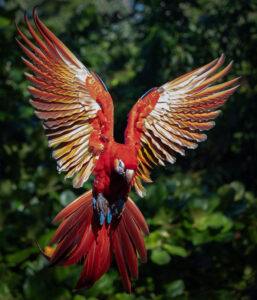 Coiba National Park is one of Panama’s most fascinating destinations for bird watching. Its vast tropical forests, mangroves, beaches, rocky islands and isolated location provide habitat for an extraordinary variety of resident and migratory birds—including species and subspecies that evolved here in isolation from their mainland relatives.
Scarlet macaws fly above the forest canopy, raptors patrol the skies, hummingbirds move among tropical flowers and seabirds gather around remote islands and rocky islets.
For serious birders, however, Coiba offers something even more compelling: the opportunity to search for birds found in very few other places—or nowhere else on Earth.
An Island Laboratory for Bird Evolution
Coiba’s birdlife has fascinated ornithologists for generations.
The archipelago’s long isolation from mainland Panama created conditions in which populations could evolve independently. Over time, some developed differences in appearance, behavior or genetics from related birds on the mainland.
This has resulted in an unusually high concentration of endemic birds and endemic subspecies.
Historically, ornithologists recognized approximately 19 resident bird populations on Coiba as endemic subspecies. Modern genetic and taxonomic research continues to examine these populations, and classifications can change as scientists learn more about their evolutionary relationships.
That makes Coiba much more than a place to add birds to a checklist. It is a living laboratory for understanding how isolation shapes evolution.
The Coiba Spinetail
For many visiting birders, the most important species is the Coiba Spinetail (Cranioleuca dissita).
This small forest bird is endemic to the Coiba archipelago, with its natural distribution restricted to Isla Coiba and nearby Ranchería Island, also known as Coibita.
The spinetail was once treated as a geographically isolated form of the Rusty-backed Spinetail of South America, but it is now recognized as a distinct species.
It inhabits forest and forest-edge environments, where it searches through vegetation for insects and other small prey.
Its restricted range makes the Coiba Spinetail one of the park’s most significant terrestrial species—and one of the birds that makes Coiba a particularly rewarding destination for dedicated birders.
Scarlet Macaws
Few wildlife encounters represent Coiba as dramatically as a pair of Scarlet Macaws (Ara macao) flying over the tropical forest.
Their brilliant red plumage makes them unmistakable, but often the first indication that macaws are nearby is their loud call carrying above the canopy.
Scarlet Macaws have disappeared from much of their former range in Panama because of habitat loss, capture and other human pressures. Coiba’s extensive forests provide an important refuge.
UNESCO specifically recognizes Coiba as a last refuge in Panama for threatened wildlife including the Scarlet Macaw, and conservation assessments identify the island as supporting Panama’s only significant population of the species.
Seeing wild macaws against an almost completely forested island landscape is one of Coiba’s signature wildlife experiences.
The Brown-backed Dove
Another important Coiba bird is much less conspicuous.
The Brown-backed Dove (Leptotila battyi) is a threatened Panamanian species with a restricted distribution. Coiba National Park is one of its important strongholds.
Unlike the brightly colored Scarlet Macaw, the Brown-backed Dove can be surprisingly easy to overlook. Its subdued plumage helps it disappear into the shaded understory and forest floor.
For birders interested in Panama’s range-restricted species, however, finding one can be among the highlights of a visit.
The Brown-backed Dove is sufficiently important to conservation that it is one of the bird species helping Coiba qualify as a Key Biodiversity Area of international significance.
Crested Eagles
Coiba’s forests are also important habitat for one of the Neotropics’ impressive forest raptors: the Crested Eagle (Morphnus guianensis).
Crested Eagles require extensive forest habitat and have disappeared from many areas affected by deforestation and human disturbance.
UNESCO specifically identifies Coiba as an important refuge for the species in Panama.
Spotting one is never something a visitor should expect or count on. Large forest raptors can be elusive even where they occur. But the fact that Coiba continues to support birds requiring such extensive habitat says a great deal about the ecological value of its forests.
Hummingbirds and Forest Birds
Some of Coiba’s birding rewards come in much smaller packages.
The park supports hummingbirds and numerous other species associated with Panama’s Pacific forests. The Blue-throated Goldentail, for example, is one of the characteristic Pacific-slope hummingbirds recorded within the archipelago.
Forest birding may also reveal flycatchers, thrushes, woodpeckers, tanagers, wrens, pigeons and doves, along with birds moving through the canopy that are more easily heard than seen.
Different species occupy different levels of the forest, making patience particularly rewarding. While one birder watches the canopy for parrots or raptors, another may discover something completely different moving quietly through vegetation closer to the ground.
King Vultures and Raptors
Looking upward can be just as productive as searching the forest.
King Vultures and other raptors can sometimes be observed soaring above Coiba’s forests, using rising warm air to travel efficiently over the island.
Hawks, falcons and other birds of prey occupy different ecological niches throughout the archipelago.
Open beaches, forest edges and boat journeys can sometimes provide better opportunities for spotting soaring birds than walking beneath a closed forest canopy.
Seabirds of the Coiba Archipelago
Bird watching in Coiba isn’t limited to Isla Coiba or its tropical forest.
The park’s dozens of islands, rocky islets and surrounding Pacific waters provide habitat for pelicans, boobies, frigatebirds, terns and other coastal and marine birds.
Some of the smaller islands are particularly important nesting and roosting sites.
Brown Pelicans, for example, have been documented nesting on Barca Quebrada, a small islet off the southern coast of Isla Coiba.
A small colony of Magnificent Frigatebirds has also been documented on an islet near Uva Island.
These small offshore rocks may appear insignificant on a map, but for nesting seabirds they can provide valuable habitat separated from many terrestrial predators and disturbances.
Brown Boobies on Jicarón
Jicarón Island adds another dimension to Coiba’s birdlife.
Researchers working on Jicarón and neighboring Jicarita have documented a surprisingly varied bird community, demonstrating that Isla Coiba isn’t the only island in the national park worth exploring with binoculars.
Brown Boobies nest in significant numbers along Jicarón’s cliffs, while ornithological surveys have continued to add new bird records for these southern islands.
Researchers have recorded forest birds, shorebirds, hummingbirds and raptors, including a Zone-tailed Hawk that represented a new record for Coiba National Park when observed during fieldwork.
A History of Ornithological Exploration
Scientific interest in Coiba’s birds stretches back well over a century, but one of the most important figures in the island’s ornithological history was American ornithologist Alexander Wetmore.
Wetmore conducted extensive fieldwork in Panama and visited Coiba while preparing his monumental studies of the country’s birds.
In 1957, he published an annotated account documenting 133 species and subspecies on Isla Coiba.
His observations established an important scientific baseline and included detailed notes about habitat, behavior and the distinctive island forms he encountered.
Later ornithologists have continued that work, surveying islands that Wetmore visited as well as places that historically received very little scientific attention.
We’re Still Discovering Coiba’s Birds
One of the most exciting things about birding in Coiba is that the story isn’t finished.
Modern biological expeditions continue to improve our understanding of bird distribution throughout the archipelago.
Researchers conducting surveys on Jicarón and Jicarita, for example, combined historical records with new observations to produce the first published annotated checklist specifically covering those southern islands.
Even relatively short expeditions have produced new park records.
This continuing research reminds us that Coiba’s remoteness has two effects: it helped preserve the islands’ wildlife, but it also means that some parts of the park remain surprisingly under-studied.
Where to Go Bird Watching
Birding opportunities begin before visitors even step ashore.
During the boat journey to Coiba, watch for seabirds flying or feeding over the Pacific. As the islands approach, scan the forest canopy and shoreline for macaws, raptors and coastal species.
On Isla Coiba, established trails such as Sendero Los Monos provide opportunities to explore forest habitat, while beaches and clearings offer wider views of the canopy.
Forest edges can be particularly productive because they allow birders to see both into vegetation and above the treetops.
Different islands provide different habitats, so visitors spending several days in the park have the opportunity to encounter a broader variety of species than those making a short visit.
Explore Wildlife & Ecotours in Coiba →
When to Watch Birds
Bird activity often changes dramatically throughout the day.
Early morning is generally the most productive period, when temperatures are cooler and many forest birds are actively feeding and calling.
Late afternoon can also be rewarding as activity increases again before sunset.
The middle of a hot tropical day is often quieter in the forest, although soaring raptors may become more visible as rising warm air develops.
Seasonal movements and migration can also change which species are present. Resident birds provide year-round opportunities, while migratory species add to the diversity during portions of the year.
Birding by Ear
In dense tropical forest, learning to listen can be just as important as looking.
Leaves, branches and vines can hide birds only a few meters away. Calls and songs often reveal their presence long before movement becomes visible.
An experienced birding guide who recognizes local vocalizations can therefore transform a walk through the forest, identifying birds that might otherwise remain completely unnoticed.
Moving slowly and quietly also increases the chance of seeing birds behaving naturally rather than simply watching them disappear into the vegetation.
What to Bring
For casual bird watching, a pair of binoculars may be all that’s necessary. Dedicated birders will benefit from bringing appropriate binoculars, a camera with a telephoto lens if desired, and a current Panama bird guide or identification app.
Lightweight clothing, sun protection, insect protection, drinking water and suitable footwear are important in Coiba’s tropical climate.
Equipment should also be protected against rain and saltwater spray. Even on a clear day, traveling between islands by boat can expose cameras and optics to moisture.
Responsible Bird Watching
Coiba’s birds should always be observed with as little disturbance as possible.
Keep an appropriate distance from nests, roosts and feeding birds. Never pursue wildlife simply to obtain a photograph, and avoid surrounding or repeatedly approaching an animal.
Playback of recorded bird calls should be used cautiously, if at all, particularly around nesting birds and sensitive species.
Visitors should remain on designated trails and follow all instructions from park staff and authorized guides.
The goal of bird watching in Coiba should be simple: observe the birds without changing what they would otherwise be doing.
A Different Side of Coiba
Coiba is internationally famous for sharks, whales, reefs and spectacular diving, but looking upward reveals another remarkable ecosystem.
Its isolation created distinctive bird populations. Its forests provide refuge for species that have disappeared from much of Panama. Its cliffs and offshore islets provide nesting habitat for seabirds. And scientists are still documenting the avian diversity of islands that have received relatively little study.
From the brilliant flash of a Scarlet Macaw above the canopy to the quiet search for an endemic Coiba Spinetail within the forest, bird watching reveals a side of Coiba that visitors who never look beyond the water can easily miss.
Explore More Things to Do in Coiba → | Explore Wildlife & Ecotours → | Explore Tours to Coiba National Park →