Wildlife & Ecotours - Coiba National Park
Wildlife & Ecotours in Coiba National Park
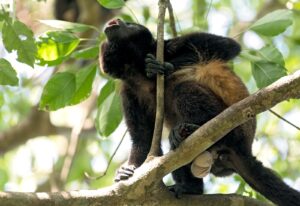 Coiba National Park is one of Panama’s great destinations for wildlife and ecotourism. Beyond the spectacular marine life surrounding its islands, Isla Coiba protects vast areas of tropical forest where monkeys move through the canopy, scarlet macaws fly overhead and birds found nowhere else on Earth inhabit forests that remain remarkably wild.
Visitors who venture beyond Coiba’s beaches and reefs discover an entirely different side of the park. Hiking trails lead through tropical forest, along mangroves and coastal habitat, and to viewpoints overlooking the islands and Pacific Ocean.
Coiba’s isolation has helped preserve this extraordinary environment. Today, exploring it responsibly offers visitors an opportunity to experience one of the most biologically distinctive island ecosystems in Central America.
A Wildlife Refuge in the Pacific
Coiba’s importance extends far beyond its scenery.
Isolation from mainland Panama allowed plants and animals on the island to develop independently over thousands of years. The result is an unusually high level of endemism—species and subspecies found only on Coiba or within the surrounding archipelago.
The island has also become an important refuge for animals that have declined or disappeared from much of mainland Panama.
Among Coiba’s best-known terrestrial wildlife are scarlet macaws, crested eagles, howler monkeys, white-faced capuchin monkeys and the Coiba Island agouti. The forests also support bats, reptiles, amphibians and an extraordinary variety of birds and insects.
Wildlife sightings are never guaranteed, but that unpredictability is part of exploring a genuine tropical wilderness.
Wildlife You May Encounter
Exploring Isla Coiba can reveal wildlife at almost every level of the forest.
Howler monkeys are often heard before they are seen. Their powerful calls can travel through the forest, creating one of the most memorable sounds of a Coiba morning.
White-faced capuchin monkeys are active and inquisitive primates that may be encountered moving through trees or searching for food near the forest edge.
The Coiba Island agouti is particularly special. This island mammal is endemic to Coiba, meaning its natural range is restricted to the island.
Overhead, scarlet macaws provide unmistakable flashes of red, yellow and blue as they travel between feeding and roosting areas.
And these are only some of the most conspicuous animals. Much of Coiba’s biodiversity is found among the smaller creatures living beneath leaves, inside trees, along streams and throughout the forest floor.
Birdlife in the Forest
Coiba is an exceptional destination for bird enthusiasts because isolation has produced distinctive island populations.
The best-known example is the Coiba spinetail, a bird found only on Isla Coiba. Other birds have developed distinctive Coiba subspecies, while the island also provides refuge for impressive species such as the scarlet macaw and crested eagle.
Different habitats produce different opportunities for bird watching. Forest trails, mangroves, beaches, clearings and coastal waters can all reveal different species.
Visitors particularly interested in birds can learn more on our dedicated birding page.
Explore Bird Watching in Coiba National Park →
Hiking in Coiba National Park
Hiking offers a completely different experience from exploring Coiba by boat.
Within minutes of leaving the shoreline, visitors can find themselves beneath a tropical canopy surrounded by vines, palms and enormous forest trees. The sounds of boat engines and waves disappear, replaced by insects, birds and monkeys calling through the forest.
Several established trails have historically provided access to different habitats on Isla Coiba. Conditions and availability can change as trails undergo maintenance or temporary closures, so visitors should always confirm which routes are currently open with park staff or their tour operator.
Sendero Los Monos — Monkey Trail
Sendero Los Monos is one of Coiba’s best-known forest walks and an excellent introduction to the terrestrial wildlife of the island.
The trail is a little over one kilometer long and lies on the eastern side of Isla Coiba, across the water from the Granito de Oro area. Its route passes through mature tropical vegetation before returning to the coastline.
The experience begins near a tropical beach before entering a shaded forest filled with vines and mature trees.
As its name suggests, monkeys are one of the attractions.
White-faced capuchins may be encountered around the forest and coastal vegetation, while the calls of howler monkeys can carry considerable distances through the trees.
Inside the Forest
Los Monos passes through a mixture of mature secondary forest and areas of older tropical vegetation.
Large trees create a dense canopy overhead while lianas descend through the forest and tropical plants compete for openings in the sunlight.
The trail also provides opportunities for bird watching. Birds recorded historically along the route include hawks, thrushes, manakins and distinctive Coiba island populations.
Near the coastline, the environment changes again. Creeks and tidal areas support crabs, molluscs and other small animals adapted to the boundary between forest and sea.
The combination of terrestrial and coastal habitats makes Los Monos one of the most varied short hikes on Isla Coiba.
Combine Los Monos with Granito de Oro
One of the advantages of the Monkey Trail is its proximity to Granito de Oro.
A visit can potentially combine two completely different Coiba experiences: walking beneath the tropical forest canopy and snorkeling among fish around one of the park’s most recognizable small islands.
It’s an excellent illustration of what makes Coiba unusual. Within a relatively small area, visitors can move from tropical rainforest to beach, rocky shoreline and underwater reef habitat.
Discover Granito de Oro → | Explore Snorkeling in Coiba →
Sendero Cerro Gambute — Gambute Trail
While Los Monos is primarily about experiencing the forest, Sendero Cerro Gambute adds something different: elevation and panoramic views.
The trail begins near the park’s administrative area at Playa Gambute and climbs steeply through tropical vegetation.
The ascent is relatively short but can be demanding, particularly in hot, humid or wet conditions. Rain can make sections muddy and slippery.
Along the way, hikers move through forest habitat where monkeys and tropical birds may be encountered.
The View from Cerro Gambute
The reward for climbing Cerro Gambute is the view.
From higher ground, visitors can look across the surrounding coastline and Pacific waters toward smaller islands and islets scattered around Coiba.
After spending much of a Coiba trip viewing the islands from sea level, seeing the archipelago from above provides an entirely different sense of scale.
Forest, coastline and ocean become part of a single landscape—an excellent visual reminder that Coiba National Park protects terrestrial and marine ecosystems together.
Sendero Los Pozos Termales — Hot Springs Trail
Los Pozos Termales is one of Coiba’s most unusual natural attractions.
The historic trail runs for approximately 750 meters through tropical vegetation toward a series of naturally heated pools associated with the island’s geology.
The route begins near Playa Venado and passes between forest and mangrove habitat, creating opportunities to observe plants, birds and other wildlife along the way.
Historically, this trail has been particularly associated with sightings of the endemic Coiba spinetail, as well as hummingbirds, monkeys, scarlet macaws and other forest birds.
Coiba’s Natural Hot Springs
At the end of the trail are Coiba’s thermal pools.
The hot water provides a reminder that the landscapes of Coiba have been shaped not only by tropical climate and the Pacific Ocean but also by geological processes beneath the island.
The pools and surrounding infrastructure have undergone maintenance and conservation work over the years as park authorities manage the site for public use.
Access to Los Pozos Termales may be temporarily restricted or closed. Visitors should confirm current conditions with MiAmbiente, park staff or an authorized tour operator before planning a visit.
Mangroves and Coastal Wildlife
Some of Coiba’s most important wildlife habitat occurs where the forest meets the sea.
Mangroves provide sheltered environments for fish, crustaceans, birds and other animals while helping stabilize tropical coastlines.
Walking near these habitats can reveal a completely different ecosystem from the taller forest farther inland.
Fiddler crabs move across exposed mud, birds search the shallows for food and juvenile marine animals use protected coastal waters as shelter.
These habitats also demonstrate why Coiba must be understood as an interconnected ecosystem. What happens in the forest can affect the mangroves, reefs and surrounding ocean—and vice versa.
From Rainforest to Reef
Few destinations make the relationship between terrestrial and marine ecosystems as obvious as Coiba.
A visitor can walk through tropical forest in the morning and, only a short boat ride later, be snorkeling above reef habitat surrounded by tropical fish.
Scarlet macaws may fly over the shoreline while rays pass through the water below. Monkeys call from forests overlooking bays visited by dolphins and sea turtles.
This connection between land and sea is one of the defining characteristics of Coiba National Park and one of the reasons the area is internationally important for conservation.
Wildlife Watching from the Water
An ecotour in Coiba doesn’t necessarily require leaving the boat.
Travel between islands provides opportunities to observe marine wildlife throughout the day. Dolphins may appear alongside boats, sea turtles surface to breathe and seabirds travel between islands and feeding areas.
During the appropriate season, humpback whales can also be encountered in Panama’s Pacific waters.
Responsible wildlife watching means giving animals space. Boats should never chase, surround or deliberately disturb wildlife, and cetacean encounters should follow Panama’s current whale- and dolphin-watching regulations.
Exploring Responsibly
Coiba is a protected wilderness rather than a conventional recreation area, and responsible ecotourism is essential to keeping it that way.
Visitors should remain on designated trails, avoid feeding or approaching wildlife, carry out all waste and never remove plants, animals, shells, rocks or archaeological material.
Wild animals should be allowed to behave naturally. A monkey approaching people should not be offered food, and birds should never be pursued simply for a photograph.
Even seemingly small actions can have consequences when repeated by thousands of visitors.
Trail Conditions and Access
Coiba’s tropical environment can change trail conditions quickly.
Heavy rain can create mud, fallen branches and slippery terrain, while tides can affect access to some coastal trailheads. Maintenance or conservation work can also result in temporary closures.
Visitors should wear suitable footwear, carry drinking water and sun protection, and be prepared for heat, humidity, insects and sudden tropical rain.
Most importantly, check current trail availability before departing for Coiba. Park staff determine which visitor sites are open, and conditions can change.
Experience the Wild Side of Coiba
The reefs and marine wildlife may initially bring many travelers to Coiba, but exploring the island’s forests reveals why this national park is so exceptional.
Coiba isn’t simply an island surrounded by beautiful water. It is a living natural laboratory where isolation has shaped plants and animals in distinctive ways and where extensive tropical forests still provide refuge for remarkable wildlife.
Walk beneath the forest canopy, listen for howler monkeys in the distance, watch scarlet macaws cross the sky and you’ll discover an entirely different side of Coiba National Park.
Explore More Things to Do in Coiba → | Discover Coiba’s Birdlife → | Explore Tours to Coiba National Park →