
Scuba Diving - Coiba National Park
Scuba Diving in Coiba National Park
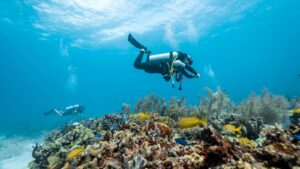 Scuba diving is one of the most extraordinary ways to experience Coiba National Park. Beneath the Pacific surrounding its forested islands lies a vast marine wilderness of rocky reefs, coral communities, underwater pinnacles, steep drop-offs and offshore banks where divers can encounter sharks, rays, sea turtles and enormous schools of fish.
Coiba’s location within the Tropical Eastern Pacific places it within one of the world’s most remarkable marine regions. Ocean currents connect these waters with other important Eastern Pacific ecosystems, while deep water and underwater topography help create the productive conditions that support an exceptional abundance of marine life.
This isn’t tropical diving defined only by colorful coral. Coiba is about big schools of fish, predators, powerful ocean conditions and the possibility that something unexpected may emerge from the blue.
Why Is Diving at Coiba So Special?
Coiba National Park protects much more than the islands visible above the surface.
The surrounding Pacific contains a complex mixture of marine habitats influenced by both continental and oceanic conditions. Rocky reefs rise from the seafloor, coral communities develop around islands and shallow areas, and underwater formations interact with currents moving through the Gulf of Chiriquí.
These conditions support an extraordinary marine ecosystem.
UNESCO recognizes the Coiba World Heritage property as habitat for 760 species of marine fish, 33 species of sharks and 20 species of cetaceans.
The park also provides habitat for sea turtles, rays and numerous species of pelagic fish, while its reefs support complex communities of smaller marine organisms.
For divers, that diversity means every descent has the potential to reveal something different.
Where Two Marine Worlds Meet
One of the keys to Coiba’s biodiversity is its geographic position.
The park lies close enough to mainland Central America to receive continental influences while also sitting near deep oceanic water.
That creates an unusual transition between coastal and open-ocean ecosystems.
Currents moving through the region carry nutrients and marine organisms across enormous distances. Where those currents encounter islands, underwater ridges and seamounts, water movement can concentrate food and create exceptionally productive habitats.
For divers, this helps explain why relatively small underwater structures can sometimes hold astonishing numbers of fish.
Sharks of Coiba
Sharks are one of the great attractions of diving at Coiba.
The wider World Heritage property supports 33 documented shark species, reflecting the extraordinary variety of marine habitats protected within the region.
Whitetip reef sharks are among the sharks divers may encounter around rocky reefs and island dive sites. They can sometimes be seen resting near the bottom or moving through reef habitat.
Other sharks inhabit deeper or more open water, and encounters depend heavily on dive location, season and ocean conditions.
Rather than treating sharks simply as an attraction, diving at Coiba offers an opportunity to see them as part of a functioning marine food web.
Healthy populations of large predators are one of the characteristics that make protected marine ecosystems so important.
Hammerhead Sharks
Few underwater silhouettes are as unmistakable as a hammerhead shark.
Hammerheads occur within the wider Coiba marine environment and can sometimes be encountered by divers, particularly around offshore or current-swept areas.
They are highly mobile animals, however, and sightings should never be treated as guaranteed.
Water temperature, currents, food availability and seasonal movements all influence where hammerheads appear.
For divers fortunate enough to encounter them, the best approach is to remain calm, avoid pursuit and allow the sharks to determine the distance of the encounter.
Whale Sharks
The largest fish in the world also passes through Panama’s Pacific waters.
Whale sharks are seasonal visitors to the broader Coiba region and are occasionally encountered around productive offshore dive sites.
Despite their enormous size, whale sharks feed primarily on plankton and small organisms filtered from the water.
Their movements are closely connected to food availability and ocean conditions, making encounters unpredictable.
A whale shark should therefore be regarded as an extraordinary possibility rather than something any dive operator can responsibly promise.
Rays and Mantas
Coiba’s waters also support an impressive variety of rays.
Bottom-associated rays can be encountered around sandy and rocky habitats, while mobula and manta rays may move through more open water.
Watching a large ray glide above a reef or appear suddenly from the blue can be one of the most graceful encounters in Pacific diving.
Some offshore structures can function as gathering or cleaning areas where large animals spend time around concentrations of smaller fish.
As with sharks, ray encounters vary according to location, season and ocean conditions.
Sea Turtles
Sea turtles are another highlight of Coiba’s marine environment.
Divers may encounter turtles feeding around reefs, resting near structure or simply traveling through the water.
Being underwater allows divers to watch these animals in an entirely different way from seeing one briefly surface beside a boat.
Turtles should never be touched, blocked or pursued. A relaxed diver who gives an animal space may be rewarded with a much longer and more natural encounter.
Walls of Fish
Some of Coiba’s most memorable dives aren’t defined by a single famous animal.
They’re defined by abundance.
Large schools of jacks, snapper, barracuda and other fish can gather around underwater structure, sometimes forming dense walls that move as though they were a single organism.
Tuna and other predators may patrol the edges while smaller reef fish remain close to rocks and coral.
This abundance is one of the characteristics divers repeatedly notice about Coiba. Even when a whale shark, hammerhead or manta doesn’t appear, the sheer quantity of marine life can make the dive remarkable.
Rocky Reefs and Volcanic Structure
Visitors expecting Coiba to look like a Caribbean coral reef may be surprised.
Much of the diving takes place around rocky and volcanic underwater structure.
Large rocks, ridges, pinnacles and steep slopes create surfaces for coral, sponges, algae and other organisms while providing shelter and feeding areas for fish.
Channels between rocks concentrate currents, while deeper edges provide routes for larger predators moving past the reef.
This rugged underwater topography is a major part of Coiba’s character.
Coral Communities
Coral is nevertheless an important part of Coiba’s marine environment.
The Eastern Tropical Pacific presents challenging conditions for reef-building corals, including fluctuations in temperature and powerful oceanographic events.
Despite those challenges, Coiba contains important coral reefs and coral communities that support diverse populations of fish and invertebrates.
One of the park’s best-known coral environments is Bahía Damas Reef along the eastern side of Isla Coiba.
These reefs are scientifically valuable as well as beautiful, helping researchers understand how Eastern Pacific coral communities respond to environmental change.
Bajo Piñón
Bajo Piñón is one of the recognized diving areas associated with Coiba’s northern islands.
The site is characterized by submerged rocky structure surrounded by deeper water, creating habitat for reef fish as well as larger marine animals moving through the area.
Schools of fish can gather around the rocks while sharks and other predators may patrol the surrounding water.
Currents contribute to the site’s productivity but can also make conditions more demanding.
As with many Coiba dive sites, the experience at Bajo Piñón can change dramatically according to the direction and strength of the current.
Wahoo Rock
Another well-known Coiba diving environment is commonly called Wahoo Rock or Buffet.
Rocky underwater formations create habitat for schooling fish and reef-associated species, while the surrounding open water provides the possibility of larger pelagic encounters.
The combination of reef life and passing oceanic animals is characteristic of Coiba diving: divers can spend one moment examining small creatures around the rocks and the next looking into the blue because something much larger has appeared.
Faro
Faro, or the Lighthouse area, provides another example of Coiba’s dramatic underwater terrain.
Dives here can involve sloping and deeper rocky habitat where schools of fish gather and sharks may move through the surrounding water.
Depth and conditions can vary across the site, allowing experienced guides to select routes according to current, visibility and diver ability.
As elsewhere in the park, divers should follow the route and depth planned by guides who know the site.
Ranchería
The waters surrounding Ranchería Island, also known as Coibita, contain several recognized diving areas.
Its location close to Isla Coiba combines island reef habitat with access to the productive channels and waters of the broader national park.
Divers may encounter coral communities, reef fish, turtles and larger animals passing through the area.
Ranchería is particularly appealing because a dive trip can reveal both sides of Coiba’s environment: tropical forest and beach above the surface, and an entirely different ecosystem below.
Jicarón and the Southern Waters
South of Isla Coiba lies rugged Jicarón Island, surrounded by exposed Pacific waters and dramatic underwater terrain.
Its offshore location creates a different character from more protected sites closer to Isla Coiba.
Rocky formations and deeper surrounding water provide habitat for schooling fish and predators, while currents can bring changing conditions throughout the day.
For divers, Jicarón is another reminder that Coiba isn’t one dive site—it is an entire archipelago of distinct underwater environments.
Hannibal Bank
For experienced divers, few names around Coiba generate as much excitement as Hannibal Bank.
Hannibal Bank isn’t an island or conventional reef. It is a massive submerged underwater formation west of Isla Coiba, rising from much deeper Pacific water.
Currents encountering the bank can force nutrient-rich deeper water upward, increasing biological productivity and attracting concentrations of marine life.
This combination of underwater topography, deep water and food availability has given Hannibal Bank an international reputation for large pelagic animals.
It is also an ecologically important reproduction and replenishment area that receives special conservation attention.
Diving Hannibal Bank
Hannibal Bank should not be confused with an easy reef dive.
It is an offshore, open-ocean environment where currents, depth and surface conditions can make diving considerably more demanding.
There is no island immediately beside the dive site to provide shelter. Divers arrive by boat and descend onto underwater structure surrounded by deep Pacific water.
Large fish, sharks, rays and other pelagic animals may pass through the area, but wildlife is unpredictable and conditions ultimately determine whether a dive is appropriate.
Hannibal Bank is best approached by experienced divers with operators who know the site intimately.
Montuosa and the Remote Pacific
Even farther into the Pacific lies Montuosa Island.
Montuosa sits within Coiba’s Special Zone of Marine Protection and is surrounded by deep oceanic water.
Its reefs and rocky underwater environments have been the subject of scientific research, and its remote location places divers in a genuinely offshore ecosystem.
Strong swell, currents, distance from assistance and changing weather mean diving in this region requires careful planning and appropriate experience.
For suitably qualified divers, however, Montuosa represents one of the wildest marine environments associated with Coiba.
Macro Life and the Small Stuff
It’s easy to become obsessed with Coiba’s biggest animals and forget to look at the reef.
Among rocks, coral and other structure are moray eels, blennies, crustaceans and numerous small reef fish.
Careful divers may discover animals that are completely invisible to someone constantly scanning the blue for sharks.
The contrast is part of what makes Coiba interesting: a dive can include enormous schools of fish and large predators while still rewarding the diver who slows down and examines a few square meters of reef.
What Are Diving Conditions Like?
Coiba is a Pacific diving destination, and conditions can be dynamic.
Currents, visibility and water temperature can all change significantly between sites and even during the same day.
Some dives may take place in relatively calm conditions, while others involve current that makes a drift-style dive more appropriate.
Visibility is influenced by plankton, rainfall, tides, currents and seasonal oceanographic conditions.
Water can also become noticeably cooler where deeper water rises toward the surface.
These changes are not necessarily negatives. Nutrient-rich water is one of the reasons Coiba supports such abundant marine life.
Thermoclines and Upwelling
Divers may occasionally pass through a thermocline—a boundary where water temperature changes noticeably over a relatively short depth.
This can be particularly apparent during periods when deeper, cooler water influences the region.
Upwelling brings nutrients toward shallower water, supporting plankton and the larger food web.
The trade-off can be cooler temperatures and reduced visibility at certain times.
For divers accustomed only to warm, crystal-clear tropical water, this can initially be surprising. But those productive Pacific conditions are part of what makes Coiba biologically exceptional.
Is Coiba Suitable for Beginner Divers?
There isn’t one simple answer because Coiba contains many different dive environments.
Some protected sites may be suitable for relatively inexperienced certified divers under appropriate conditions, while current-swept pinnacles, deeper sites and offshore locations can require considerably more experience.
A diver’s certification card alone doesn’t tell the whole story.
Recent diving experience, comfort in currents, buoyancy control, air consumption and ability to enter and exit a boat in Pacific conditions all matter.
Good dive operators match sites to both the conditions and the abilities of the divers rather than taking every group to the same location.
Advanced Diving
Experienced divers can find plenty to challenge them at Coiba.
Strong currents, deeper underwater structure, negative or rapid entries where appropriate, open-water safety stops and remote offshore locations can all form part of more advanced diving.
Divers interested in sites such as Hannibal Bank should discuss their experience honestly with the operator before booking.
The reward for that additional experience is access to some of Coiba’s most dramatic underwater environments.
Dive Certification
Visitors planning recreational scuba dives should hold an appropriate recognized diving certification for the dives they intend to make.
Operators may have additional experience or certification requirements for particular sites because of depth, current or remoteness.
Anyone who hasn’t dived recently should consider refreshing their skills before undertaking a demanding multi-dive trip.
Coiba is far more enjoyable when basic buoyancy, mask, regulator and emergency skills are already comfortable and automatic.
When Is the Best Time to Dive Coiba?
Coiba can be dived during much of the year, but conditions and wildlife change with the seasons.
Panama’s Pacific climate has distinct wetter and drier periods, while changes in currents and ocean temperature influence visibility and the animals moving through the region.
Some seasons may offer warmer water or calmer conditions, while others bring nutrient-rich upwelling and different marine-life opportunities.
Highly mobile animals such as whale sharks, mantas, hammerheads and whales follow their own biological and oceanographic patterns.
There is therefore no single month that guarantees the “best” Coiba dive.
The better question is what kind of conditions and marine encounters you hope to experience.
Seasonal Wildlife
Some of Coiba’s most famous marine visitors are seasonal.
Humpback whales migrate into Panama’s Pacific waters during part of the year, while whale sharks and other pelagic animals can also show seasonal patterns.
Even during a favorable season, however, wildlife remains unpredictable.
Responsible operators should describe these encounters as possibilities rather than guarantees.
One of Coiba’s strengths is that the resident marine ecosystem is impressive even when a famous seasonal visitor doesn’t appear.
Day Trips and Multi-Day Diving
Many divers visit Coiba on boat trips from communities along Panama’s Pacific coast, with Santa Catalina serving as one of the established gateways to the park.
A day trip can provide an excellent introduction, usually combining several dives with travel through the archipelago.
Multi-day diving allows operators greater flexibility to explore different areas and respond to changing conditions.
More remote destinations require substantially more travel and planning and may be included only on specialized itineraries.
Visitors should compare trips based on the actual dive sites, travel distances, diver experience requirements and park permissions rather than simply the number of dives advertised.
Surface Intervals in Paradise
One unusual pleasure of diving at Coiba is what happens between dives.
Surface intervals may take place surrounded by forested islands, tropical beaches and wildlife rather than a developed marina.
Scarlet macaws can fly above the shoreline, sea turtles may surface near the boat and dolphins can appear while traveling between sites.
Depending on the itinerary and current access rules, divers may also stop at approved beaches or visitor areas.
It means the experience doesn’t stop when the dive ends.
Diving in a UNESCO World Heritage Site
Coiba National Park and its Special Zone of Marine Protection were inscribed on the UNESCO World Heritage List in 2005.
That recognition reflects the global importance of the area’s terrestrial and marine ecosystems.
For divers, visiting a World Heritage marine site comes with responsibility.
Coral should never be touched or collected. Divers should maintain good buoyancy, avoid disturbing resting animals and never chase sharks, rays or turtles for photographs.
Nothing should be removed from the marine environment.
The objective should be to leave no evidence that the dive ever happened.
Buoyancy Matters
Good buoyancy control is one of the most important skills a diver can bring to Coiba.
Even brief contact from a fin, knee or piece of equipment can damage fragile marine organisms.
Proper weighting and horizontal trim allow divers to remain comfortably above the reef while dealing with cameras, current and changing depth.
If you haven’t dived recently, refreshing your buoyancy skills before arriving can improve both your safety and your impact on the environment.
Underwater Photography
Coiba can be an extraordinary destination for underwater photographers.
Wide-angle opportunities include schooling fish, sharks, rays, turtles and dramatic underwater structure, while smaller reef animals reward photographers willing to slow down and look closely.
But getting the photograph should never take priority over the animal.
Don’t chase wildlife, block escape routes or make contact with the reef while concentrating on a camera.
The best Coiba photographs document natural behavior rather than disturbing it.
Choosing a Coiba Dive Operator
The quality of the operator matters enormously in a remote diving destination.
Before booking, ask about:
- the experience and certification expected for the planned dive sites;
- group sizes and divemaster-to-diver ratios;
- boat safety and emergency equipment;
- oxygen and first-aid equipment;
- how dive sites are selected according to current and weather;
- procedures for lost-diver or separation situations;
- park permits and authorization;
- equipment condition and rental options; and
- how the operator approaches wildlife and reef protection.
An experienced operator should be willing to change or cancel a dive when conditions aren’t appropriate.
In Coiba, flexibility is a sign of good judgment—not poor planning.
Remote Diving Requires Preparation
Part of Coiba’s attraction is its remoteness.
That remoteness also means divers should take preparation seriously.
Medical assistance and recompression facilities are not immediately beside many dive sites. Boat travel can be lengthy, and weather can affect how quickly assistance can be reached.
Divers should disclose relevant medical conditions to their operator, follow established no-decompression limits, maintain conservative ascent practices and remain adequately hydrated.
Dive insurance that covers emergency evacuation and diving-related treatment is worth considering for any remote diving trip.
Protecting the Marine Life You Came to See
The abundance that makes Coiba famous should never be taken for granted.
Illegal fishing, tourism pressure and climate change remain concerns for the World Heritage property.
Divers can help by supporting responsible operators, following protected-area rules, maintaining excellent buoyancy and reporting obvious environmental damage or illegal activity through appropriate channels.
Tourism works best for Coiba when the presence of visitors creates an incentive to keep sharks alive, reefs healthy and marine habitats protected.
Scuba Diving vs. Snorkeling
Visitors who aren’t certified divers can still experience Coiba’s underwater world.
Snorkeling provides access to suitable shallow-water habitats where tropical fish, turtles, rays and other marine life may be encountered.
Scuba diving adds another dimension by allowing visitors to remain underwater longer and explore deeper rocky reefs, slopes, pinnacles and offshore environments.
Neither activity is inherently better. They simply reveal different parts of the same remarkable ecosystem.
Explore Snorkeling in Coiba National Park →
Expect the Unexpected
Perhaps the best way to approach diving at Coiba is without a checklist.
A dive planned in hopes of seeing sharks may instead produce an enormous school of jacks. A quiet reef dive may suddenly be interrupted by a ray passing overhead. A trip between dive sites may produce dolphins—or the distant blow of a whale.
Wild places don’t follow itineraries.
And that unpredictability is one of Coiba’s greatest strengths.
Dive into Coiba National Park
There are places where scuba diving is about a single famous wreck, reef or species.
Coiba is different.
Here, the attraction is an entire marine ecosystem: forest-covered islands above the water, rugged volcanic structure below it, huge schools of fish around the reefs and an open Pacific where sharks, rays, turtles and pelagic animals continue to move according to rhythms much older than tourism.
That sense of wilderness is what makes diving at Coiba extraordinary.
You descend without knowing exactly what you’ll encounter—and that’s precisely the point.
Explore More Things to Do in Coiba → | Discover Hannibal Bank → | Explore Bahía Damas Reef → | Explore Tours to Coiba National Park →